Among the World’s Most Spoken
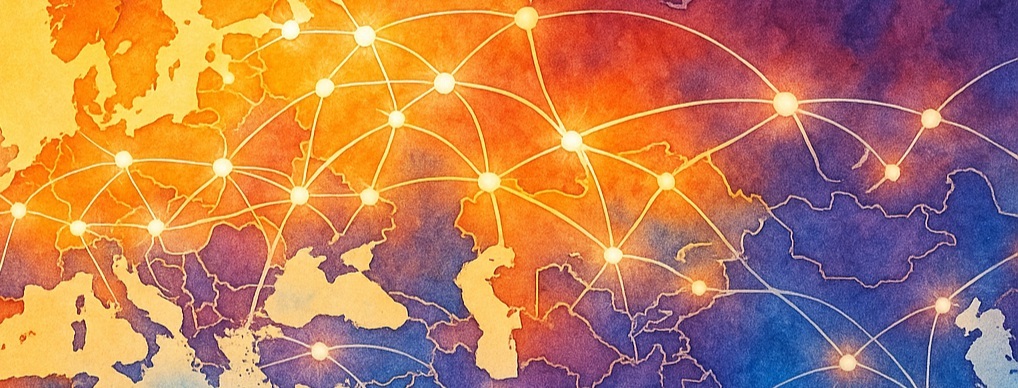
Russian is used across Eastern Europe and Central Asia, and by large diaspora communities worldwide. It serves as a common language in many parts of the former Soviet region*.
*Usage varies by country/region and context; always be mindful of local preferences.
Two Blues
“Abstract paint swatches of light-sky голубой and deep-navy синий, luminous brush strokes, glossy reflections, rich contrast, museum catalog style, label tags in Latin + Cyrillic, teal–indigo–ultramarine palette, crisp lighting.”
Russian cleanly splits “blue” into two basic color terms. You’ll also meet expressive relatives like синевá (bluishness) or голубизнá (light-blue tinge). Fun twist: some languages don’t even separate “blue” and “green,” but Russian leans into blue’s many moods.
Tip: Try noticing signs and packaging—once you see the split, you see it everywhere.
Language of Spaceflight
“ISS interior with bilingual Russian/English labels, astronaut studying a Russian checklist, soft rim lighting, cinematic teal–violet space glow visible through the window, crisp typography, high detail, editorial photo look.”
Astronauts headed to the International Space Station traditionally study Russian for crew coordination, manuals, and systems—especially for training on the Союз spacecraft and ISS modules originally built in Russia. Even today, Russian pops up in checklists, labels, and radio call-outs.
Phrase to know: “Готов!” (Ready!)
A Big Lexicon, A Small Core
“Playful word-tree made of Cyrillic letters, roots branching into prefixes/suffixes, colorful leaves labeled ‘re-’, ‘-ness’, Russian equivalents like ‘пере-’, ‘-ость’, creamy paper texture, warm bookish palette (ochre, emerald, plum), infographic aesthetic.”
Russian builds families of words through prefixes and suffixes. From one root, you can grow verbs, nouns, and adjectives with shades of meaning—great news for learners: once you know key roots and the ~2–3k most frequent words, you can understand a lot.
Try tracking families like: пис- (write): писать, запись, подписка…
EEE!? Triple “Е” in a Row
“Whimsical Cyrillic typographic poster featuring ‘змеееед’ and ‘длинношеее’, giant stacked ‘Е’ letters, bright candy colors (magenta, cyan, lemon), glossy print finish, minimalist grid, museum poster vibe.”
Russian sometimes stacks three “е”s in a row when parts come together. You’ll see examples like змееед (snake-eater, i.e., snake eagle) or длинношеее (long-necked). Don’t panic—pronunciation is straightforward once you split the parts.
Pro move: mark syllables to see where morphemes meet.
Names Carry Family History
“Elegant family tree on textured paper, name tags in Cyrillic/Latin (e.g., Ivan Ivanovich / Anna Ivanovna), subtle gold foil accents, cranberry–forest green palette, soft vignette, classic book illustration style.”
A full formal name often includes a given name, a patronymic (from the father’s first name), and a surname. Patronymics usually end with -ович (son of) and -овна (daughter of). Many surnames also change form by gender (e.g., Иванов → Иванова).
Example: Иван Иванович Петров / Анна Ивановна Петрова.